Pages

Tuesday, March 27, 2012

No Longer Writing as We Once Knew It

"And in the here-now of the World Wide Web, of the blipvert soundbite, of the writing that is no longer writing as we once knew it, we are all finding ourselves responsible for making connections, for finding ways to learn and to teach new forms of making cultural meanings." (Johnson-Eilola, 226)

I'm reading "The Database and the Essay" by Johndan Johnson-Eilola in Writing New Media, and I come to the very end of the piece and read the above quote. I just smile. This line is a great definition on how I feel about teaching writing, or in other words, how I feel about incorporating the new types of writing in the English curriculum.

For examples, I am a huge advocate of alternative forms of writing, especially writing that incorporates technology. For a while, I was really into having students create videos. I also like using videos as a way to introduce material. As I was reading Johnson-Eilola discuss other forms of writing, such as working with sound tools, I think back to a video on YouTube that I used as a way to preface a similar assignment I was having my students do. For my assignment, they students were required to reenact something they had read in class, but with a modern spin. Below is a "music video" on the Oedipus story. Warning: it is very cheesy, but it does a great job of taking an ancient story and retelling it in a modern (maybe more relatable) way.


As a teacher, I completely agree with Johnson-Eilola. I find myself responsible for giving students the opportunity to make connections and find and understand cultural meanings. Isn't that the point of literacy? To just push "literacy" without it being meaningful to the students, are they truly grasping literacy? Between the Common Core State Standards and the many types of literacy, today's society seems to be very much literacy minded. As teachers of English (well any discipline, really), we need to constantly be reminded that writing is no longer what it used to be: pen and paper. It is now something so much more, especially due to the explosion of technology. 

Thursday, March 22, 2012

Copyright Infringement

I'm working in the media center at the high school. I have a little down time, and I try to finish reading "The Database and the Essay" by Johndan Johnson-Eilola in Writing New Media. However, I have decided to take a moment to vent my frustration. Maybe I'm totally taking it the wrong way, but I think people have gone sue crazy. Remember that lady who bought a hot McDonald's coffee and then sued them for not warning her it was hot. Come on! You just bought a hot coffee. Do you expect it to be cold?

I'm reading the court cases the Johnson-Eilola references, and it just makes me slightly irritated. Today's society is so stuck on owning things that I feel many people are losing the drive to become creative because they might step on someone's toes.

I've taught high school English, and I love when an assignment is able to finally make their light bulb click on. I love creativity. I feel every student has something to say. It's just a matter of finding a way for them to say it that works for them. Every student can write; it's just a matter of finding out HOW they write.

I know, it seems as if I'm jumping all over the place. Trust me, I'm going somewhere with this. Anyway, imagine if someone were to come in my high school English classroom and peruse my students' writings. Many of them would probably be brought to court for stealing someone else's work. Now, I don't mean as in plagiarism, which I'll give a brief comment on that in a second. I mean as in originality of the work.

Every person (not just my high school students) is influenced and impacted by the world around them, whether it is music, movies, books, etc.  Now many times, how they respond and relate to that influence could come out in their writing. Is this really wrong? I don't think is. I think the important thing is that they are writing and expressing themselves. This would mean that half of the words written on a blog (I made up this statistic; it might very well be more than half) are not original. What do you expect when you live in a world with billions of people, and billions more who have existed over the past few thousand years that have left their mark on society?

As for plagiarism, I believe that is a different thing entirely. If you KNOWINGLY cite someone's work, you should give them the credit. If you do it unknowingly, well...that's a different matter. I think a lot of creativity could be lost due to the emphasis on copyrighting and copyright infringement. Yes, there is an importance in it, but if too much emphasis is put in it, it might deter people from writing (or being creative, in general). As a teacher, I want to teach my kids to desire literacy, not pull away from it. Okay, I think I'm done ranting. I'll go finish reading what Johnson-Eilola has to say.

Tuesday, March 13, 2012

New Media = Visual Literacy

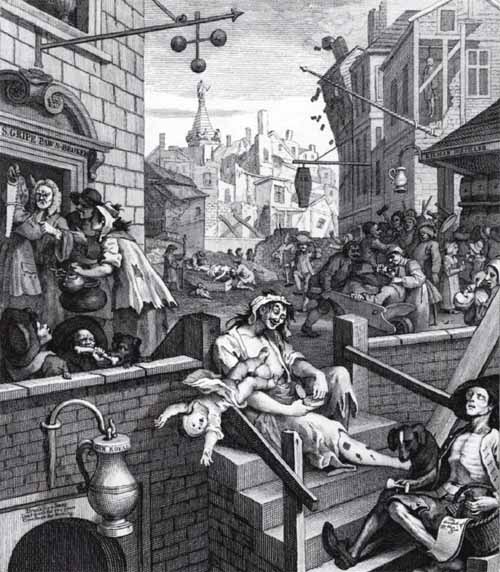
As I was finishing reading Anne Wysocki's "The Sticky Embrace of Beauty" in Writing New Media, I was drawn to the time that I was observing a twelfth grade English classroom for students with disabilities. In preparation for reading Jonathan Swift's A Modest Proposal, the students observed, analyzed, discussed, etc. William Hogarth's engraving, Gin Lane. For your viewing pleasure, here is a picture of the engraving:

Gin Lane by William Hogarth

Now, as you're sitting observing the picture, take a few seconds to really look at what Hogarth is trying to portray. Okay, I know that it is slightly disconnected from what Wysocki discusses, but I have realized how much visual literacy shapes a literary work (Wysocki, 149), such as Hogarth to Swift. I think that many times as an English teacher, I find teachers using visuals as just another discussion tool, but why not use it to preface the text and to shape the text? 

I think by incorporating visual literacy this way, it gives students another way to think about literacy as a whole. As seen in previous blogs, I am extremely passionate about literacy, especially since there is a major emphasis in the primary and secondary schools due to the Common Core State Standards. For those of you who know Jonathan Swift's A Modest Proposal, how might you use visual literacy, such as the above picture, to connect and shape the text?

Mapping Readings

Mapping readings -- something I enjoy incorporating into my English curriculum. As I was reading through the various activities that Anne Wysocki suggests in "Opening New Media in Writing" from Writing New Media, I was oddly surprised that I was at least familiar with the majority and had incorporated many of them at some point in the past.

Okay, back to mapping readings. Why do I find them useful? Well, I think it's pretty simple for two reasons: (1) I'm an English teacher and (2) I'm a special education teacher. As for English, I think it is important for students to visualize what they are reading and why. Many times I hear students complain that they don't understand why they are reading a particular novel, short story, poem, etc. However, if I can give them something for them to see how it is connected, it makes my life much easier because they now have something concrete. I also don't have to hear them ask the same question 16 million times and can tell them to just refer to their reading maps. So am I slightly selfish...maybe...

As for special education, well it gives great visual representation. I know, I already said this in regards to teaching a general education English class. But, really, students who are struggling in the classroom need multiple representations in order for them to understand the material. The more visuals they have, the better off they are. I'm a graphic organizer, visual junky, and I having students map their readings just feeds into my love for incorporating visuals into the curriculum.

What I loved that Wysocki suggested was having the students come up with three questions on their own after putting together the map and have them bring those questions to class to help lead the discussion (35). I have done many activities in my classroom that "forced" the students to lead the discussion, but I, honestly, never would have thought of using the mapped reading to be the basis for a class discussion. When I did reading maps it was more for informational purposes.

In my future classes, I would like to have the students use their mapped readings to form higher level thinking questions. This is a great opportunity for them dig into the text and really analyze and synthesize the information they are reading. I will be curious as to how my students with reading and writing disabilities are able to use this extension of the activity to help them better understand what they are reading and how they think about the reading. My assumption is that it will take some modeling and a few practices for them to grasp the concept, but once they are used to working with the model, I know that it will be beneficial.

Wednesday, March 7, 2012

English, LANGUAGE!, and Literacy

So this post may be my way of venting, but I will try to relate it back to digital literacy. At the high school I work at the special education department uses the LANGUAGE! program as a substitute for English. From a literacy and English background, I find it a completely inappropriate substitute. By using this program, I feel the high school is doing a disservice to the students in multiple ways. One, I don't believe it fully covers the High School Content Expectations, with one area being technology. Two, it doesn't properly prepare the students for the ACT/MME. Three, the students know that what they are doing relates nothing to the English classes their peers take. Four, the goal of the program is to be a supplement for the general education classroom. Five...well I think you get my point. I'll move on.

LANGUAGE! is more of a grammar based program. When I say grammar, I refer to more of the grammar that one learns in elementary school. I don't think grammar is bad. Actually I find it completely and totally necessary in education. However, teaching grammar day-in and day-out can become monotonousness to both the teacher and students. So, where's this going?

Well, currently I'm advocating for phasing out LANGUAGE! and phasing in an English resource classroom at the high school I work at. I'm a huge advocate of literacy, which includes technology and digital literacy. However, the students don't get the opportunity in the current program, as they would in a normal classroom. It is so important to teach students to be digitally literate by the time they graduate high school, and I believe teaching of this digital literacy should be incorporated in the English curriculum.

Now, grant it, the below video is more general on the type of classroom where technology can be used, but if the students are on such a structured curriculum, how can a teacher expect to incorporate technology and other aspects of literacy?


Thursday, February 23, 2012

Digerate, Digeracy/Digiracy, & Digital Literacy


Okay, so I've spent the past week looking at the word "literacy" and has it has transformed over time into the phrase digital literacy. However, through this new phase of digital literacy, or the "new" literacies, the words "digerate," "digeracy," and "digiracy" have been coined. How much did I find on it? Well, little to nothing. I found a lot on digital literacy, but it seems a majority of the world has not adapted to this new way of saying digital literacy.

I did find this really different site that talks about being "digerate." The entire site is based on stretch-text, which is a new form of writing I have discovered. I haven't decided whether or not I really like the idea of stretch-text. At this point in time, I'm leaning towards the side of it being annoying and slightly aggravating as I'm not 100% sure where the text is taking me. Anyway, off my rant. Click the screen shot to explore the website. I'm curious to see what other people think of this set up.


As I've been exploring the new terms for digital literacy, I have discovered that I am not that adventurous and will not jump on the bandwagon...well, what seems to be a very small bandwagon. I, honestly, don't like the terms "digerate," "digeracy," and "digiracy." I feel that if it's not broken, don't fix it, and "digital literacy" has been doing a darn good job at describing...well...digital literacy. I feel that these "other" terms are doing the phrase an injustice. Is it really that hard to say digital literacy that it needs to be shortened? Okay, I'm ending my little tirade.

What I think is happening is that people think blending two words into one is a great idea. However, not everything needs to be one word. For some things it works, but for others it doesn't. Our language may become quite morphed if we continue to lean toward phrases modulating into one word. I say just leave it as digital literacy and bury "digerate," "digeracy," and "digiracy." I know this is just an opinion after doing research on the history of the word, but I'm entitled to my opinion, right?

Monday, February 13, 2012

Search Engines: Process of Finding & Learning

"The difficulty is that the searcher does not always know precisely what she means; if she did, she would have little need of searching. The word 'search' suggests that a person is interested in finding something that has been lost. People do use search engines for this, particularly to 're-find' information often they are hoping not to 'find' but to 'learn,' or to 'discover.' Perhaps, then, the ideal search engine does not just understand what you desire, but knows what the user wants even when she does not know herself." (Halavais 35)

I never really took the time to ponder what search engines do to our world, to the education system, to my every day life. I can't even tell you how many times I've used a search engine. I can guarantee that, today alone, I have "Googled" a word or phrase AT LEAST a few dozen or so different times. Honestly, I do not know what life was like before search engines, specifically Google...because I am a Google-junkie.

As I was reflecting on this particular passage from the chapter, I immediately thought of one of the teachers I work with who teaches world history. This particular teacher has decided to implement a research project, as a way to introduce the beginnings of research writing. The students' task: search a topic and write about the findings.

The students think the project is monotonousness. However, what they have found is that by merely searching what they think is a common topic, they end up learning something they didn't know. As I have had the opportunity to watch them search and see the light bulb go on (since I work a few hours a week as a media specialist), I have been able to connect what Halavais means about the finding-learning/discovering connection.

Students do not realize that "the ideal search engine does not just understand what [they] desire, but knows what [they want] even when [they do] not know [themselves]" (Halavais 35). Since students do not always realize this truth, I believe that a part of the role as a teacher is to show students all the advantages of search engines. Many times, teachers assume students know everything about technology, but I have found that students only know what they use everyday (such as Facebook, Twitter, etc.) or really just what they WANT to know. Teachers need to take the time to educate students on all the possibilities technology has. You never know, something might peak their interest. Although, isn't that the goal of teaching--to help the students find connections to their lives and interests?